Resin diamond polishing pads have become a core tool in modern stone processing. However, surveys show that over 60% of users fail to achieve satisfactory polishing results or exceed their budgets due to improper operation. Mastering the correct usage methods can not only improve the surface treatment quality of stones like marble and granite but also extend tool life by more than 30%. This article will provide a detailed analysis of the scientific workflow for using resin diamond polishing pads, helping you avoid common mistakes and achieve efficient, cost-effective polishing operations.
Polishing Pad Selection: Matching the Grit Sequence to Stone Characteristics
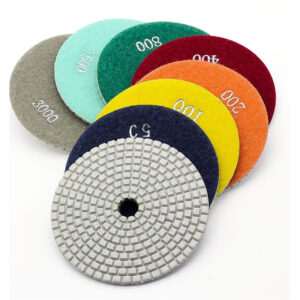
Choosing the right polishing pad sequence is foundational to success. Resin diamond polishing pads are categorized by grit into three main types: coarse grinding, fine grinding, and fine polishing.
50#-200#: Used for repairing deep scratches and shaping, such as leveling seams in granite countertops.
400#-800#: Intermediate polishing to remove grinding marks from the previous stage.
1000#-3000#: Fine polishing to achieve a preliminary gloss.
BUFF Series: Final mirror finish, using resin-based soft polishing pads.
For example, when polishing Spanish Cream marble, the correct sequence is: start with a 200# pad to remove installation scratches, proceed through 500#, 1000#, 2000#, and finish with a BUFF pad to achieve a gloss level above 90 degrees. In 2023, a stone factory in Xiamen skipped the 500# pad and directly used a 1000# pad, resulting in incomplete removal of grinding marks. They had to redo the work, incurring a labor cost loss of over 4,000 RMB for that single project.
Pre-Operation Preparation: The Hidden Factor Determining Polishing Quality
Thorough preparation directly affects polishing results and cost control:
Stone Diagnosis: Check the stone type (marble/granite/engineered stone), hardness, and extent of existing damage. Granite requires starting with a coarser grit.
Surface Treatment: Ensure the adhesive surface is secure, cracks are repaired, and joints are fully filled. Moisture content should be below 5%.
Equipment Matching: Use a light hand polisher (<175 RPM) for small-area detailed work and a heavy bridge cutter for large-area projects.
Environmental Control: The recommended ambient temperature for operation is 15-30°C. Low temperatures can cause the resin bond to become brittle.
A construction team in Jiangsu once polished Egyptian Cream marble in low winter temperatures without pre-warming the material. This caused the diamonds to detach from three 1500# polishing pads. Subsequent inspection revealed the temperature was 12°C below the recommended minimum.
Operating Technique: The Science of Combining Pressure, Angle, and Path
Three-Stage Pressure Control Method
Initial Contact: Apply gentle pressure (approx. 1-2 kg) for the first 30 seconds to allow the pad to fully adapt to the stone surface.
Stable Operation: Maintain even, medium pressure (approx. 3-4 kg). Judge by sound—a consistent friction noise indicates appropriate pressure.
Finishing Stage: Gradually reduce pressure over the last 10 seconds to minimize heat buildup.

Angle and Movement Path
Keep the polishing pad completely parallel to the stone surface. Use a strip movement path with a 1/3 overlap. The common “circular” polishing method causes uneven wear, leading to “haze lines.” In the stone renovation project at Shenzhen Bao’an Airport, the technical team used a straight back-and-forth path. This method saved 25% time compared to traditional methods and improved gloss uniformity by 40%.
Cooling and Lubrication: The Key to Extending Pad Life
The resin bond is temperature-sensitive, making adequate cooling essential:
Water Cooling System: Maintain a continuous water flow, recommended at 2-4 liters per minute.
Dry Polishing Notes: Only use specific dry polishing pads, and limit continuous operation to 30 seconds per session, accompanied by temperature monitoring.
Timely Cleaning: Check the pad surface every 5 minutes and remove accumulated slurry.
A processing plant in Shuitu Town, Fujian, once continued operation after a water pump failure interrupted the water supply. This single incident damaged twelve 800# polishing pads, resulting in a direct loss of over 2,000 RMB. Subsequent inspection showed localized temperatures exceeded 180°C, causing the resin to carbonize.
Case Study: Granite Renovation in a Hotel Lobby, Hangzhou
In March 2024, the lobby floor of a five-star hotel in Hangzhou, made of Indian Red granite, showed severe scratches (0.2-0.5mm deep). The construction team followed this process:
Damage Assessment: Used a hardness tester to confirm a Mohs hardness of 6.5.
Step-by-Step Grinding/Polishing:
Remove deep scratches with a 50# resin pad (2 passes).
Transition with a 150# pad (1 pass).
Base polish with a 500# pad (2 passes).
Fine polish with 1000#/2000#/3000# pads (1 pass each).
Mirror finish with BUFF pads (2 passes).
Parameter Control:
Time per pass: 2-3 minutes
Water flow: 3 liters/minute
Total time: 4.5 hours per 100 square meters
Result: Gloss level increased from 35 to 92 degrees, with uniformity reaching 95%. Polishing pad consumption was 2 pads less than planned, primarily due to controlled pressure and adequate cooling.
Common Errors and Cost Impact Analysis
Skipping Grits: Jumping directly from 200# to 1000# leaves intermediate grinding marks, increasing rework rates by 70%.
Uneven Pressure: Excessive pressure on edges causes uneven pad wear, reducing pad life by 50%.
Neglecting Cooling: Continuous operation beyond recommended times causes the resin bond to fail and diamonds to detach.
Equipment Mismatch: Using fine-grit pads on high-speed polishers instantly generates excessive heat, burning out the pads.
A stone factory in Yunfu, Guangdong, reported that after standardizing operations, the polishing cost per square meter dropped from 8.7 RMB to 5.2 RMB. This saving was mainly due to extended pad life and reduced rework rates.
Maintenance and Storage Guidelines
Clean polishing pads immediately after use. Remove residual slurry with a soft brush and hang them vertically to dry. The storage environment should be dry (humidity <60%), and pads should be stored without stacking to prevent deformation. Maintain a usage record for each pad to track its service life. Under normal conditions, a resin diamond polishing pad can process 80-150 square meters of stone (depending on hardness). Replace the pad when its efficiency drops by 30%.
Industry Trends and Technological Innovations
The 2024 Stone Processing Exhibition revealed that new-generation resin diamond polishing pads are evolving in two directions: First, multi-layer diamond distribution technology is increasing pad life by 40%. Second, intelligent color-changing indicator layers are being introduced—the pad edge displays a warning color when wear reaches the replacement point. It is advisable to follow keywords like “low-temperature polishing technology” and “wet/dry dual-use polishing pads,” as these technologies are reshaping traditional construction methods.
Mastering the correct techniques for using resin diamond polishing pads is crucial not only for significantly improving stone surface treatment quality but also for controlling costs and enhancing competitiveness. Standardized operations yield not just immediate polishing results but also extended tool life and optimized overall costs. In today’s stone processing industry, where profit margins are shrinking, these technical details often determine a project’s break-even point.